2-Day Tour from Marrakech to Merzouga Desert
A 2-day tour from Marrakech to Merzouga Desert is the most thrilling short adventure in Morocco. In just 48 hours, you will cross the High Atlas Mountains at 2,260 metres, explore the UNESCO-listed Aït Ben Haddou, and wake up at 5:30 AM to watch the Sahara sunrise from camelback. This guide covers everything you need to plan your trip confidently — routes, costs, camp options, and honest advice no travel agency will tell you.
The Logistics: Distance, Drive Time, and “The Reality Check”
The straight-line distance from Marrakech to Merzouga is approximately 560 km (350 miles) — deceptively short on paper. The reality is mountain switchbacks, high-altitude passes, and roads that reward patience over speed. Your driver will cross the Tizi n’Tichka Pass at 2,260 metres (7,415 feet) elevation, Morocco’s highest paved mountain crossing, which alone takes well over an hour each way.
Total driving time per day sits at 9 to 10 hours, punctuated by landmark stops. Plan accordingly: this is not a comfortable coach ride. It is, however, one of the most scenic overland routes in the world.
2-Day Tour from Marrakech to Merzouga Desert
Merzouga vs. Zagora: Route Comparison
| Factor | Merzouga (Erg Chebbi) | Zagora (Erg Lehoudi) |
| Distance from Marrakech | ~560 km | ~360 km |
| One-way drive time | ~9–10 hrs | ~5–6 hrs |
| Best for families/kids | Up to 150 m — iconic | Smaller, more modest |
| Camel trekking quality | Excellent, open erg | Good, shorter routes |
| Feasibility in 2 days | Tight but possible | Comfortable pace |
| Crowd level at the dunes | Challenging | More suitable |
| Crowd level at dunes | Moderate (manageable) | Lower |

Is 2 Days Tour from Marrakech to Merzouga Desert Worth It? (A Decision Matrix)
Rather than a vague “it depends,” here’s a concrete framework to help you decide whether to book the Marrakech to Merzouga desert tour — or look at alternatives.
✔ Book This Tour If:
- You have only 2 days free and refuse to miss the Sahara
- You’re a photography enthusiast chasing dusk and dawn light
- You’re comfortable with “fast travel” and long drives
- You travel solo or as a couple without young children
- Erg Chebbi’s massive dunes are specifically on your bucket list
✘ Consider Skipping If:
- You suffer from motion sickness (Atlas curves are relentless)
- You’re travelling with toddlers or children under 8
- You want to explore Todra or Dades Gorge (need a 3-day tour)
- You value leisurely sightseeing over destination-focused travel
- You have back or health issues aggravated by long car rides
2-Day Tour from Marrakech to Merzouga Desert
Day 1: Marrakech to Erg Chebbi — “The Longest Day”
You’ll depart Marrakech early — typically between 7:00 and 8:00 AM. Every minute of daylight matters on Day 1. Here’s the route broken into its key landmark stops:
Tizi n’Tichka Pass (2,260 m)
Morocco’s highest mountain pass — crossed around 9:00 AM on a typical departure. Panoramic views over the High Atlas are breathtaking and worth a short photo stop. Many roadside Argan Oil Cooperatives line the road here, run by Berber women’s collectives. A 15-minute browse supports local artisans and gets you authentic argan products at fair prices.
Aït Ben Haddou (UNESCO World Heritage Site)
One of the best-preserved earthen fortified cities (ksour) in North Africa, Aït Ben Haddou earned its UNESCO World Heritage status for good reason. Film buffs will recognise it from Gladiator, Game of Thrones, Lawrence of Arabia, and dozens of other productions. Allow 60–90 minutes to walk inside the ksar. A local guide at the entrance is optional but illuminating.
Ouarzazate & the Rose Valley
Known as “the Gateway to the Sahara,” Ouarzazate marks where the Saharan plateau begins. A quick lunch stop here before continuing through the scenic Dades Valley — famous for its Damask rose cultivation (especially beautiful in April) — and on through the palm groves of Skoura.
The Night Experience: Luxury vs. Standard Camp
You’ll arrive at Erg Chebbi around 6:00 PM. Timing is everything: a sunset camel trek into the dunes is the reward for the long drive. Here’s what to expect from each camp tier:
| Luxury Camp (~€80–150/person) | Standard Camp (~€25–55/person) |
| Private en-suite tent with toilet | Shared toilet facilities |
| Wi-Fi (often available) | No Wi-Fi — true off-grid experience |
| Electricity & charging points | Solar lanterns only |
| Higher quality bedding & linens | Comfortable blankets provided |
| Multi-course set dinner menu | Traditional Berber tagine dinner |
What the Sahara night actually feels like: Berber drumming around the fire, then absolute silence so complete you hear your own heartbeat. Stars with zero light pollution — the Milky Way visible as a solid ribbon overhead. Fine, cool sand between your fingers; air dropping 15°C after sunset. Bring warm layers.
Day 2: The Sahara Sunrise and the Dash back to Marrakech
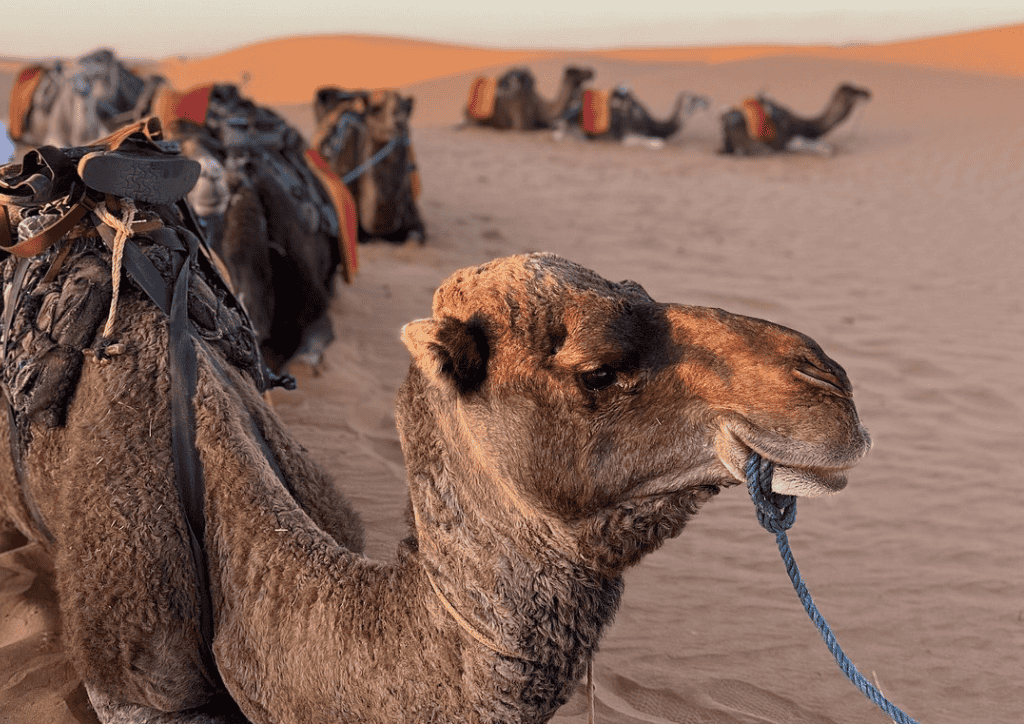
Your guide will wake you at 5:30 AM. This is non-negotiable and entirely worth it. The sunrise camel trek up to a dune crest is the single image most travellers carry home from this 2 days tour Marrakech to Merzouga. Dunes blush from indigo to deep orange in the span of fifteen minutes.
Sandboarding tip: Most standard camps offer a basic foam board for sandboarding after sunrise. It’s free, chaotic, and completely unmissable. Ask your guide before you descend from the dunes.
After breakfast at camp, the return route swings through the Draa Valley — at over 1,100 km, Morocco’s longest river — and the fortified town of Agdz, offering a completely different landscape to the outward journey. Expect to arrive back in Marrakech between 9:00 and 11:00 PM.
Temperature warning: Even in summer, desert nights drop sharply. In winter (November–February) temperatures can fall below 5°C after midnight. Pack a warm layer regardless of season.
How to Choose the Best Tour Operator
2 Days Tour from Marrakech to Merzouga Desert
The quality of your Marrakech to Merzouga desert tour depends almost entirely on your operator. Here’s a practical checklist for evaluating anyone you consider booking with:
- Full price transparency before you book. A reputable operator discloses all costs upfront — meals, guiding, camp fees, and any optional activities. Hidden add-ons are a red flag. Tips are never required, though always appreciated for excellent service.
- Private vs. shared group options. Private tours cost more but offer total flexibility on stops and timing. Shared tours are more economical and still excellent for solo travellers. Ask explicitly which you’re booking.
- Licensed local guides. Ensure your guide holds a Moroccan National Tourist Guide qualification. This matters for entry to UNESCO sites like Aït Ben Haddou.
- Vehicle quality. Reputable operators use 4×4 Land Cruisers or equivalent for the dune section. Ask what you’ll be driving in before you commit.
- Solo traveller alternative: Supratours bus. The public Supratours coach runs Marrakech–Merzouga and costs a fraction of a private tour. The trade-off: no sightseeing stops whatsoever. Best suited to travellers who only want the desert camp experience.
FAQ: Straight Answers to Common Questions
Can I do Merzouga in 1 day from Marrakech?
No — not in any meaningful sense. The round trip alone is 1,120 km of driving. Even if you somehow made it to Erg Chebbi, you’d turn around immediately and arrive home near midnight having seen nothing. A 2-day tour from Marrakech to Merzouga is the absolute minimum.
Is this too much driving for children?
Generally, yes, for children under 8. Two consecutive days of 9–10-hour drives through mountain switchbacks is genuinely difficult for young children. A much better option for families is the Marrakech to Zagora tour, which is only 5–6 hours each way and still offers an authentic desert camp experience.
Do I need to bring my own sleeping bag?
No — all camps, standard and luxury, provide bedding. However, do bring a warm jacket or fleece for the night and early morning, when temperatures drop significantly even in summer. A light headlamp is also useful for navigating camp after dark.
Is there Wi-Fi in the desert camps?
Luxury camps often provide Wi-Fi via satellite connection, though it can be slow and intermittent. Standard camps typically have no internet access at all — which many travellers consider a feature, not a bug. Moroccan SIM cards often have a partial 4G signal in Merzouga town, if you need connectivity.
What time of year is best to go?
October to April is the sweet spot. Temperatures are comfortable during the day (20–28°C) and dramatically cool at night. Summer (June–August) sees daytime heat exceeding 45°C in the dunes — possible but gruelling. March–April also coincides with the Rose Festival in the Dadès Valley, adding cultural richness to your route.