Morocco Tour Package
Okay, picture this: you’re standing on a sand dune at Erg Chebbi just as the sun comes up, the whole Sahara turning this insane shade of pink, and it’s so quiet you can literally hear your own heartbeat. Or you’re sitting on a rooftop in Fes at dusk while the call to prayer echoes across the whole city like something out of a movie. Yeah — Morocco is that place.But here’s the thing nobody tells you before you book: those dreamy moments come with a 10-hour drive through the Atlas Mountains, the “luxury desert camp” that turns out to be a nylon tent, and entrance fees that somehow keep appearing out of nowhere and quietly eating your budget alive.
1. What kind of Morocco tour is right for you?
“Morocco tour” is one of those terms that covers everything from a budget group bus trip to a private driver whisking you between five-star riads. Let’s break it down.
Private tours — your trip, your rules (but you’ll pay for it) This is the “treat yourself” option. You get a dedicated driver-guide, you go where you want, stop when you feel like it, and eat on your own schedule. Honestly ideal for couples, families, or anyone with a specific thing they’re obsessed with (food, architecture, photography — no judgment). Budget around $150–$250/day per person. GET MOROCCO VCATION
Group tours — instant travel friends, zero spontaneity Fixed dates, set itinerary, 8–16 people in a van together. You’ll probably lose the ability to linger over that one perfect alleyway, but you might make friends for life — especially great if you’re traveling solo. Costs are much friendlier at $80–$130/day. G Adventures skews younger and budget-focused; Intrepid genuinely caps groups at 12 (they actually enforce it, which is refreshing).
Luxury and “all-inclusive” — read the fine print, seriously Fair warning: “all-inclusive” means basically nothing in Morocco — it’s completely unregulated. Some packages genuinely include everything; others throw in breakfast and slap a fancy label on it. Always ask exactly what’s included before you hand over your credit card. Real luxury runs $250–$500+/day and should mean licensed guides, a proper riad, and a desert camp with an actual en-suite bathroom. Desert Majesty is one of the better names in this space.
Local Berber-owned agencies — the underrated gem Honestly? These are often the best value and the most meaningful experience. Berber-owned agencies in Marrakech or Merzouga typically offer competitive prices and guides with real personal ties to the places you’re visiting. Just make sure they’re ONMT-licensed. Watch out for red flags like mystery stops at carpet shops, vague contracts, or guides who introduce themselves as your “friend” rather than a licensed professional.
| Type | Price/day | Flexibility | Group size | Cultural depth | Lead time |
|---|---|---|---|---|---|
| Private | $150–$250 | High | 1–6 | High | 2–4 weeks |
| Group | $80–$130 | Medium | 8–16 | Medium | 4–8 weeks |
| Luxury | $250–$500+ | Medium | 2–8 | Variable | 6–12 weeks |
| Local Berber | $70–$150 | High | 1–10 | Very high | 1–3 weeks |
2. Visas, flights and all the boring-but-important stuff (2026 update)
Do you need a visa? If you’re from the US, UK, or EU — good news, you don’t! You get 90 days visa-free. Your passport just needs to be valid for at least six months after your travel dates (so don’t forget to check that). If you’re from Southeast Asia or certain African countries, you’ll likely need to apply in advance. Always double-check on Morocco’s official government site before you book anything.
Getting there The main airports are Mohammed V in Casablanca, Menara in Marrakech, and Fes-Saïs. Ryanair and easyJet run cheap, frequent routes from London, Madrid, and Paris — so flights are pretty painless. Feeling adventurous? The Tarifa–Tangier ferry from southern Spain is a gorgeous overland option if you’re coming from Europe.

Travel insurance — don’t skip this one EU folks, your EHIC card is useless here — Morocco isn’t covered. Make sure your policy includes medical evacuation (this matters a lot if you’re doing desert or mountain stuff), trip cancellation, and adventure activities. World Nomads and True Traveller both cover Morocco specifically
Quick pre-trip checklist before you forget:
- Passport valid 6+ months past your return date
- Visa sorted for your nationality
- Travel insurance with medical evacuation
- Moroccan Dirhams — just grab them from an ATM on arrival
- Pack something modest (knees and shoulders covered for medinas)
- Read your tour contract and confirm what’s actually included
3. How long should your Morocco trip be?
7 days — imperial cities sprint Casablanca → Marrakech → Fes. Great for first-timers who are short on annual leave. No Sahara, but honestly that’s fine — better to do the cities properly than rush everything. Book this if: you’ve only got a week.
10 days — the classic (and the most popular for good reason) Same cities, plus the Sahara. Overnight camel trek and a night in the desert is the absolute highlight of most people’s Morocco experience. This is the sweet spot. Book this if: it’s your first Morocco trip.
14 days — the full picture Add Chefchaouen (yes, it’s as blue and beautiful as Instagram says), Essaouira on the Atlantic coast, and some High Atlas trekking. This is the one. Book this if: Morocco has been on your bucket list for years.
14+ days — the off-the-beaten-path route Draa Valley, the quieter Erg Chigaga dunes, nomadic family visits, fossil beds. Very different vibe from the standard tours. Book this if: you’ve been before and want something new.
Sample 10-day itinerary: Day 1: Land in Marrakech, check into your riad, get pleasantly lost. Days 2–3: Marrakech proper — Djemaa el-Fna, Bahia Palace, souk maze. Day 4: Drive through Aït Ben Haddou (genuinely stunning, worth the stop) to Ouarzazate. Day 5: Draa Valley to Merzouga. Day 6: Camel trek into the dunes, night in the desert camp. Day 7: Wake up for sunrise on the dunes (set your alarm — it’s worth it), then drive north through Ziz Gorge. Days 8–9: Fes — medina walking tour, tanneries, the famous Blue Gate. Day 10: Transfer back to Casablanca or Marrakech and fly home.
Pro tip: the Draa Valley route adds about 90 minutes but takes you through date-palm oases and ancient ksar villages that most tours completely skip. Totally worth it.
4. What does Morocco actually cost? The honest breakdown
| Budget level | Per day | What you get |
|---|---|---|
| Backpacker | $30–45 | Hostels, street food, shared taxis, lots of wandering |
| Mid-range | $80–120 | Riad stays, some guided tours, proper restaurants |
| Comfort | $130–180 | Boutique riads, private driver, nice experiences |
| Luxury | $250–500+ | 5-star riads, private chefs, glamping, helicopters if you fancy |
The sneaky extras nobody mentions Airport transfers are almost always listed as “optional extras” — read: they cost extra. Add entrance fees (Hassan II Mosque is $14, Bahia Palace $8), tips for guides and restaurant staff, and the solo traveler supplement on group tours. Realistically, budget an extra $20–35/day on top of whatever your package quote says.
Cash, cards and bargaining Moroccan Dirhams are what you need — grab them from an ATM when you land. Cash is king everywhere outside the big cities. In the souks, bargaining is not just acceptable, it’s expected. Start around 40–50% of the opening price and work up. Just don’t try to bargain in restaurants or riads — that’s not how it works and it’ll just be awkward for everyone.
When to book Riads fill up fast — book 4–6 weeks ahead normally, 8–12 weeks if you’re going during peak season (March–May or October–November). Last-minute deals during Eid or New Year? They basically don’t exist. Don’t count on it.
5. Getting around Morocco without losing your mind
Trains (ONCF) — Comfortable and reliable between the big cities (Casablanca–Marrakech and Casablanca–Fes). Cheapest option for those routes. They don’t go to the desert or mountains though, so you’ll need something else for those legs.
CTM and Supratours buses — These cover the routes trains don’t, like Ouarzazate, Zagora, and Essaouira. Air-conditioned, reasonably comfortable, book in advance during peak season.
Taxis — Grand taxis handle the intercity routes (shared or private — always agree on price before you get in). Petit taxis are the metered city ones. Classic taxi move: the meter is mysteriously “broken.” Just insist on the meter, or don’t get in.
Private driver vs. renting a car — For desert routes and mountain roads, a private driver is genuinely worth it. If you want to drive yourself, you can, but the N9 mountain pass (Tizi n’Tichka) is not the place to discover you’re not great at mountain driving. Do it in daylight and only if you’re comfortable with winding roads.
6. Where to sleep — riads, guesthouses and those desert camps
What’s a riad, anyway? It’s a traditional Moroccan house built around a central courtyard — think plain, unassuming exterior, then you step inside and it’s all ornate tiles, fountains, and rooftop terraces. A dar is basically the same thing but without the garden. When you’re booking, check: is there a real courtyard (not just a skylight pretending to be one), is it properly licensed, do the staff speak English?
Where to stay in each city In Marrakech, staying in a medina riad is the move — it’s noisy, it’s chaotic, and it’s completely magical. Guéliz (the new city) is easier to navigate if that matters to you. In Fes, the medina stay is worth it for the full immersion experience. In Chefchaouen, go small — family-run guesthouses beat big hotels every time in a city that intimate.
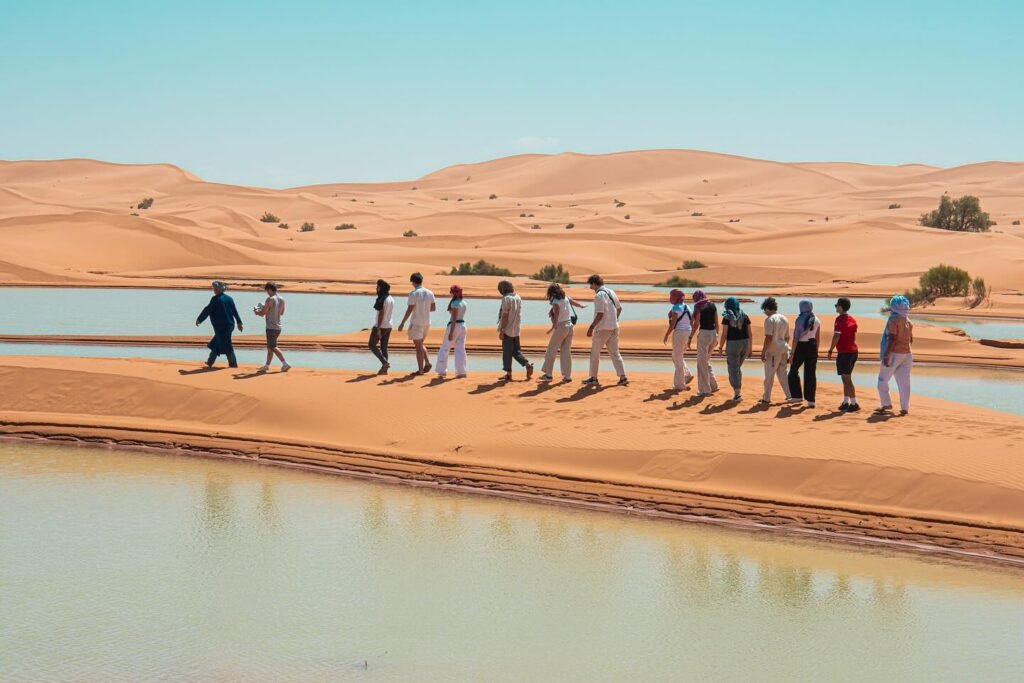
Desert camp reality check Budget camps ($40–60/night) = basic tents, shared bathrooms, you’re there for the stars and that’s enough. Standard glamping ($80–150) = private tent, en-suite, proper dinner. Luxury ($200–400) = private butler, gourmet food, the works. Whatever tier you’re booking, ask the operator: “Can I see actual photos of the specific tent I’ll be in?” If they get evasive, that’s your answer.
7. Morocco for every type of traveler
Solo female travelers — Morocco is absolutely doable solo as a woman, and loads of people do it every year. Harassment in the souks is real but manageable — confident pace, minimal eye contact, and a guided tour for your first day or two makes a big difference. Several operators also offer female guides specifically.
Families with kids — Great news: Morocco’s actually really fun for families, especially on a private tour where you control the pace. Camel rides at Erg Chebbi, the beach at Essaouira, hands-on cooking classes — kids love it. Just maybe skip the packed medinas at peak season with toddlers in tow.
Honeymoons and couples — A riad with a rooftop terrace and a private hammam, a sunset camel trek in the desert, mint tea on a balcony overlooking the Fes medina… yeah, Morocco’s pretty romantic. Desert Majesty is one of the better operators for couple-focused itineraries.
Adventure travelers — Toubkal Summit (4,167m, the highest peak in North Africa) is a proper two-day trek from Marrakech and absolutely worth doing. Erg Chigaga is the quieter, more remote desert alternative to the more touristy Erg Chebbi. Multi-day trekking with a Berber guide is genuinely one of Morocco’s most underrated experiences.
8. Food, culture and not accidentally being rude
What to eat Start with tagine (a slow-cooked stew with preserved lemon and olives — it’s as good as it sounds) and couscous (traditionally a Friday thing). Then you need to try pastilla — it’s a flaky pastry filled with chicken or pigeon, almonds, and powdered sugar, which sounds weird but is genuinely one of the best things you’ll eat in your life. Harira is a hearty tomato-lentil soup perfect after a long day, and msemen is the flaky flatbread you’ll want at every breakfast. Grilled kefta from street stalls is usually safe; just peel your fruit and stick to bottled water. Vegetarians will actually do better than they expect — lots of Moroccan dishes are plant-based by default.
The secret to not overpaying for food: skip the restaurants right on Djemaa el-Fna with laminated menus and someone outside waving you in. Go one alley deeper and look for plastic chairs, no English menu, and a handwritten board on the wall. That’s where the good stuff is.
If you’re there during Ramadan Restaurants have reduced hours during the day and some services slow down. But honestly? The evenings during Ramadan are incredible — iftar (the breaking of the fast at sunset), night markets, the whole atmosphere of the medinas after dark. It’s a genuinely special time to visit. Just be respectful and eat and drink discreetly in public during daylight hours.
Basic etiquette (don’t skip this part) Cover your shoulders and knees when you’re in medinas or near mosques. Ask before you photograph anyone — especially women and in religious spaces. Learn three Darija phrases: shukran (thank you), labas (I’m fine/okay), and la, shukran (no thank you) — that last one will save you approximately 47 times per souk visit. Use your right hand for eating and passing things; the left hand is considered unclean in traditional settings.
Tips — yes, they’re non-negotiable Morocco’s service staff rely on tips as a significant part of their income, so this isn’t optional. Restaurants: 5–10%. Your private guide: $5–10/day minimum. Hotel staff: $1–2 per bag. Hammam attendants: $2–3. Factor it into your budget from the start.
9. Quick answers to questions you’re definitely googling
Is Morocco safe in 2026? Yes, genuinely. It’s one of the most stable, tourist-friendly countries in North Africa. Petty theft and pushy souk vendors are about as bad as it gets for most visitors. Book a reputable operator and use common sense.
How many days do I actually need? 10 is the sweet spot for a first trip — cities plus Sahara without feeling completely frantic. 7 works if you skip the desert. 14 is the dream if you can swing it.
Best time to visit? March–May or October–November — comfortable temperatures everywhere. Summer is brutal in the south (think 45°C brutal). Winter is cold in the mountains but great for avoiding crowds.
Is the Sahara drive worth it? Yes. A thousand times yes. It’s about 9–10 hours each way from Marrakech, but break it up over 2–3 days with stops and the journey becomes part of the experience. The dunes at dawn are worth every kilometer.
Can I do Morocco on a tight budget? Absolutely — $35–45/day gets you a real, comfortable trip. Even at $100/day you’re staying in boutique riads with private guides. It’s genuinely affordable.
Do I need a guide? For the first day in Fes or Marrakech’s medina — yes, honestly. You will get lost in ways that GPS cannot help you with. After that, exploring on your own is half the fun. For the Sahara and High Atlas, always go with a local guide.
Do people speak English? Most people in tourism do, and younger Moroccans in cities increasingly do too. French is more widely spoken generally. A tiny bit of Darija goes a long way and people absolutely appreciate the effort.
Is Morocco LGBTQ+ friendly? Legally, same-sex relations are technically illegal, and public displays of affection are generally discouraged even for straight couples in conservative areas. In practice, LGBTQ+ travelers visit without incident by being discreet. Know the legal context and travel accordingly.
How do I avoid souk scams? The most classic one: a friendly stranger offers to help you find your destination for free, then somehow ends up at a carpet shop where he earns a commission. Just politely decline unsolicited help, know where you’re going before you leave your riad, and download Google Maps offline. And bargain — always bargain. The first price is never the real price.
Recommend Post < Yoga Retreat in Merzouga
>
[…] M’Hamid El Ghizlane au Maroc, c’est opter pour le temps long, l’effort récompensé par la beauté des paysages, et […]